
Deep-Tech Research & Hardware Development
Photonic Interference: AI Computation at the Speed of Light
Dynex Photonic Interference is a new product line focused on developing a radically different approach to artificial intelligence computation: using light, interference, and programmable bio-organic materials to execute neural-network operations directly in the optical domain.
Today’s artificial intelligence systems are primarily executed on electronic processors. Data is moved through digital memory, multiplied across electronic circuits, and processed step by step through GPUs, accelerators, and data-center infrastructure. This approach has enabled extraordinary progress, but it also comes with growing limitations: increasing energy consumption, rising hardware cost, memory-bandwidth bottlenecks, latency constraints, and the challenge of scaling ever-larger AI models efficiently.
Photonic interference offers a different computational paradigm.
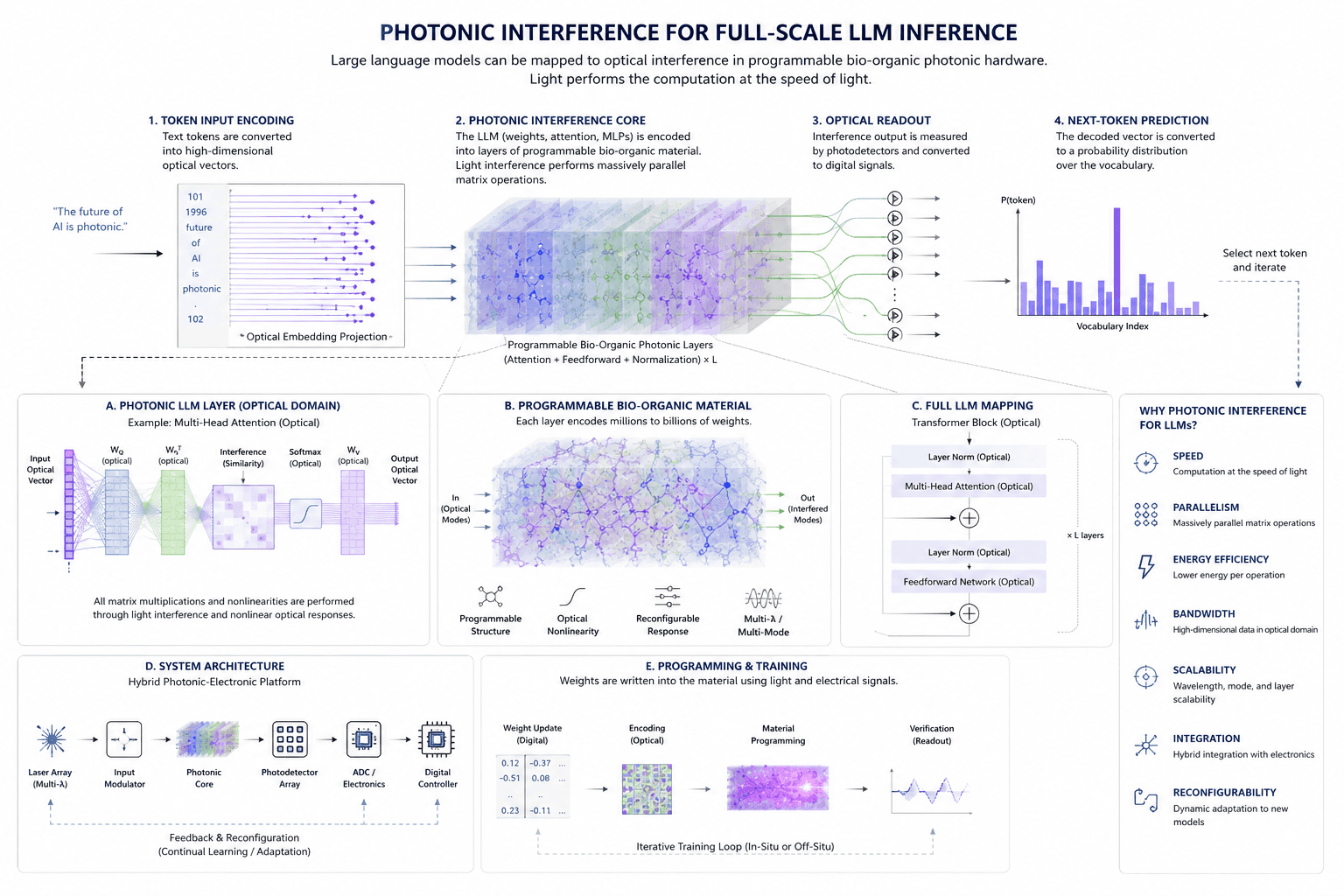
Instead of moving every operation through conventional electronic logic, Dynex is developing systems where neural-network structures, model weights, and AI transformations can be physically represented inside programmable optical materials. Light passes through these programmed layers, interferes according to the encoded structure, and produces an output that can be read by optical sensors.
In this architecture, computation is not only calculated. It is physically expressed.
What Is Photonic Interference?
Photonic interference is the controlled interaction of light waves to perform computation.
When light waves overlap, they can reinforce or cancel each other depending on their phase, amplitude, wavelength, and the optical medium they pass through. This phenomenon is known as interference. In nature, interference is a wave effect. In computing, it can become a powerful mechanism for performing mathematical transformations.
Many neural-network operations are fundamentally based on matrix multiplication, weighted summation, signal transformation, and non-linear processing. These are exactly the kinds of operations that can be mapped onto optical systems. By programming how light propagates through a material, a photonic system can perform large numbers of operations in parallel as the light travels through the device.
Dynex Photonic Interference is being developed to use this principle for AI.
The objective is to create programmable optical systems where neural networks, large language models, diffusion models, and other AI architectures can be embedded into physical photonic structures and executed through controlled light propagation.
Programming AI Into Light
The central idea behind Dynex Photonic Interference is to program AI models into bio-organic optical materials.
These materials are being developed to change their optical properties in response to controlled programming signals. By modifying how the material absorbs, transmits, delays, shifts, or modulates light, it becomes possible to encode computational weights directly into the optical path.
In a conventional AI accelerator, model weights are stored in digital memory and repeatedly fetched during computation. In a photonic interference system, the goal is to represent these weights physically inside the optical medium itself.
A light pattern enters the system.
The programmed material transforms the light.
Multiple optical paths interfere.
The output pattern represents the computed result.
A sensor reads the result and converts it into usable information.
This creates the foundation for a new type of AI hardware: one where computation happens as light moves through the system.
Bio-Organic Materials as Programmable Optical Layers
Dynex’s approach is based on the use of programmable bio-organic materials as active optical layers.
These materials are designed to act as reconfigurable computational media. Their optical properties can be programmed to represent different weights, transformations, and inference structures. Once programmed, the material can guide, filter, modulate, and interfere light in a way that corresponds to an AI model’s internal computation.
This opens the possibility of creating multi-layer photonic systems that behave like physical neural networks.
Each layer can represent a transformation.
Each optical interaction can contribute to inference.
Each interference pattern can encode part of the computation.
Each readout can represent the result of an AI operation.
Instead of treating AI models as purely digital software running on electronic processors, Dynex Photonic Interference explores AI as a physical optical process.
Why Photonic AI?
Artificial intelligence is increasingly limited not only by algorithmic complexity, but by hardware efficiency.
Large models require enormous numbers of matrix operations. These operations demand memory movement, electrical switching, and thermal management. As models grow larger, the energy and infrastructure requirements become increasingly significant.
Photonic AI has the potential to address several of these bottlenecks.
Light can travel extremely fast.
Optical signals can operate with massive parallelism.
Interference can perform transformations naturally.
Optical systems can reduce certain forms of electronic data movement.
Programmable materials can store computation directly in the physical medium.
Inference may be executed with low latency and high throughput.
Dynex Photonic Interference is being developed around this long-term opportunity: to create AI systems that are not merely faster versions of electronic processors, but fundamentally different computational architectures.
AI Inference Through Interference
One of the most important target applications for photonic interference is AI inference.
Inference is the process of using a trained model to generate an output. In large language models, this means producing text, reasoning steps, tool calls, or structured outputs. In vision models, it means recognizing objects, classifying images, or generating visual content. In scientific AI, it can mean predicting molecular structures, optimizing physical systems, or identifying patterns in complex data.
Photonic interference can be used to accelerate parts of these workloads by mapping model operations into optical transformations.
For example, a prompt, image, signal, or encoded input can be projected into the photonic system as a light pattern. The system then transforms this input through programmed optical layers. The resulting interference pattern is measured and interpreted as the model output or as an intermediate representation that is further processed electronically.
This hybrid architecture combines the speed and parallelism of optics with the programmability and control of digital systems.
Large Language Models and Optical Computation
Large language models are among the most computationally demanding AI systems ever built. They require repeated transformations of high-dimensional vectors, attention mechanisms, feed-forward layers, and token-generation steps.
Dynex Photonic Interference is being developed as a platform for exploring how parts of these operations can be moved into the optical domain.
The objective is not simply to replace software with glass. The objective is to rethink where computation happens.
In a photonic interference architecture, selected model components may be embedded into programmable optical layers. These layers can perform structured transformations on optical representations of data. The result is a system where light itself becomes part of the computational process.
This could be relevant for:
Large language model inference
Small and specialized language models
Edge AI assistants
Scientific AI models
Diffusion models
Signal-processing AI
Pattern recognition
Autonomous systems
Optimization workloads
Real-time decision systems
The most immediate opportunity is not necessarily to host the largest possible AI model in optics, but to develop compact, specialized, high-throughput AI engines that perform targeted inference tasks with exceptional efficiency.
Beyond Digital Acceleration
Most AI accelerators remain digital at their core. They improve speed by adding more transistors, more memory bandwidth, more parallel compute units, and more specialized instruction sets.
Photonic interference takes a different route.
It uses the physical behavior of light as the computational mechanism.
This distinction matters. In digital systems, multiplication and summation are operations executed by electronic circuits. In photonic systems, parts of these operations can emerge naturally through propagation, modulation, and interference.
That means a properly designed optical system can perform certain transformations without stepping through every operation in the same way a digital processor would.
Dynex is exploring this as a new class of computational hardware: not only faster electronics, but AI-native physical computation.
What Can Photonic Interference Be Used For?
Photonic interference is relevant wherever high-speed, high-throughput, low-latency AI computation is required.
AI Inference Acceleration
Photonic systems can be designed to accelerate neural-network inference by performing optical matrix operations and transformations at very high speed. This may be especially relevant for models that need fast responses, efficient deployment, or repeated execution at scale.
Potential applications include:
Language-model inference
Computer vision
Sensor fusion
Signal classification
Edge AI systems
Real-time decision engines
Scientific model inference
Industrial automation
Autonomous robotics
Edge AI and Portable Intelligence
Many AI systems today depend on cloud infrastructure. This creates challenges around latency, cost, privacy, connectivity, and power consumption.
A compact photonic AI engine could enable more advanced inference directly at the edge, closer to where data is produced.
This is relevant for:
Autonomous vehicles
Drones
Robotics
Industrial machines
Medical devices
Security systems
Smart infrastructure
Defense and aerospace platforms
Remote sensing systems
By reducing dependency on large centralized data centers, photonic interference could support more distributed, resilient, and responsive AI.
Scientific and Industrial Computing
Many scientific and industrial workloads involve pattern recognition, optimization, simulation support, and high-dimensional data analysis.
Photonic interference may be useful for:
Molecular and materials discovery
Signal analysis
Spectroscopy
Imaging systems
Computational chemistry support
Process optimization
Anomaly detection
High-speed classification
Physics-informed AI
Because light-based systems are naturally suited to wave-based transformations, photonic interference may also become highly relevant for applications that already involve optical, electromagnetic, or spatial data.
Real-Time Sensing and Decision Systems
Photonic interference is especially powerful when combined with sensor inputs.
Instead of capturing sensor data, digitizing it, transferring it to a processor, and then running inference, a photonic system can potentially process optical or encoded sensor information directly.
This creates opportunities for real-time perception systems where speed is critical.
Use cases include:
Machine vision
Quantum sensing readout
Industrial inspection
Aerospace monitoring
Defense sensing
Medical imaging
Environmental monitoring
High-speed anomaly detection
In these systems, the boundary between sensing and computing begins to disappear.
The sensor, the model, and the processor can become part of one integrated physical architecture.
Who Is Photonic Interference Relevant For?
Dynex Photonic Interference is relevant for organizations that are pushing the limits of AI hardware, model efficiency, and real-time computation.
This includes:
AI infrastructure companies seeking new accelerator architectures
Research institutions working on photonic computing and physical AI
Semiconductor and hardware companies exploring post-GPU computing paradigms
Defense and aerospace organizations requiring low-latency autonomous intelligence
Industrial companies needing real-time inspection and control systems
Robotics and autonomous-systems developers
Medical technology companies working with imaging and high-speed inference
Telecommunications and signal-processing companies
Cloud and edge-computing providers
Scientific computing teams working with complex model-based workflows
Photonic interference is not a general-purpose replacement for every form of computation. It is a new computational layer for workloads where optical transformation, parallelism, latency, and physical efficiency can create a meaningful advantage.
A New Architecture for Physical AI
Dynex Photonic Interference is part of a broader vision: the transition from purely digital AI to physical AI.
In physical AI systems, computation is not confined to software instructions running on electronic processors. Instead, the physical properties of materials, light, waves, quantum effects, and analog dynamics become part of the computational process.
This is a major shift.
AI models are no longer only stored in memory.
They can be embedded into physical media.
Inference is no longer only executed by electronic logic.
It can be expressed through optical propagation.
Computation is no longer only a sequence of instructions.
It can become a physical transformation.
Dynex is developing photonic interference technology to explore this new frontier: AI models programmed into matter, executed by light, and read out as intelligence.
Compact, Programmable, and Scalable
The long-term objective of Dynex Photonic Interference is to develop compact and programmable optical AI systems with a small physical footprint.
The platform is being designed around several core principles:
Programmable bio-organic optical materials
Multi-layer photonic interference
Optical encoding of neural-network weights
High-speed light-based inference
Compact system architecture
Hybrid optical-electronic readout
Support for AI, neural networks, and model-based computation
This creates a path toward specialized AI hardware that can be configured for different models, tasks, and industries.
From Model Weights to Optical Matter
The defining idea of Dynex Photonic Interference is that model weights do not always have to remain abstract digital numbers.
They can become physical optical structures.
A neural network can be programmed into material.
A prompt can be projected as light.
The model can transform that light through interference.
The result can be read as computation.
This is a fundamentally different way to think about artificial intelligence hardware.
It turns AI from something that only runs on chips into something that can be built into the physical behavior of matter itself.
The Future of AI Hardware
The future of artificial intelligence will not be defined by software alone. It will also be defined by the hardware architectures capable of running increasingly complex models efficiently, quickly, and sustainably.
Dynex Photonic Interference is being developed to address this next frontier.
By combining programmable bio-organic materials, optical interference, neural-network architectures, and compact system design, Dynex is working toward a new generation of AI computation — one where light becomes an active computational medium.
This is AI beyond conventional electronics.
This is computation through interference.
This is the foundation of Dynex Photonic Interference.