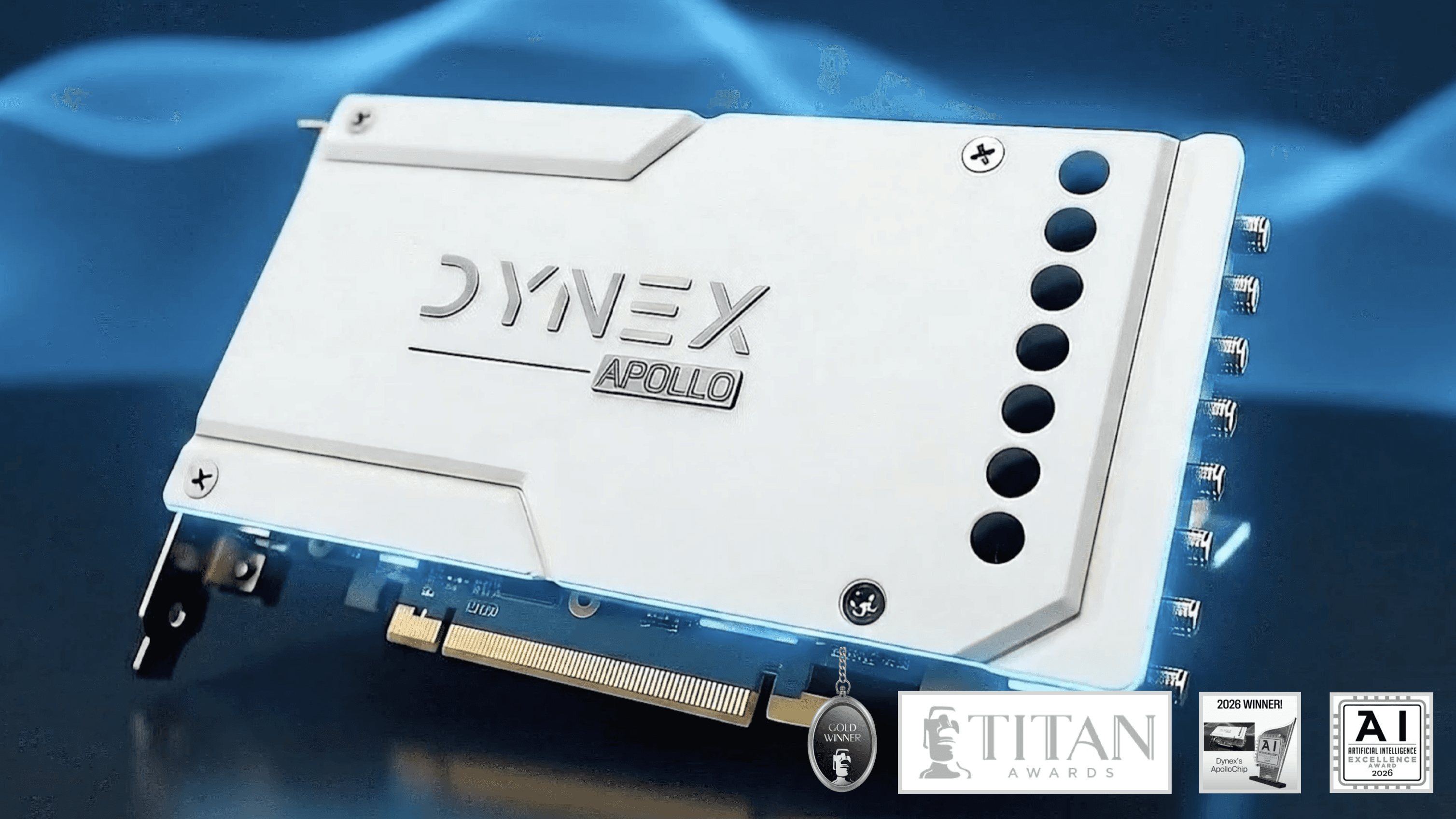
Apollo represents an award winning quantum-driven analog computing architecture which is operational today and demonstrates benchmark performance exceeding currently available commercial quantum systems in several optimization domains, including 3D spin-glass benchmarks where Apollo achieves lower ground states than publicly reported D-Wave systems.
Within the Dynex platform, Dynex's award winning Apollo chip operates alongside Dynex’s quantum processor Zeus and classical high-performance compute resources. Applications can therefore execute across multiple backend architectures while using a unified programming environment. This design philosophy enables Dynex to support heterogeneous quantum computing workflows in which workloads are mapped to the most suitable computational substrate.
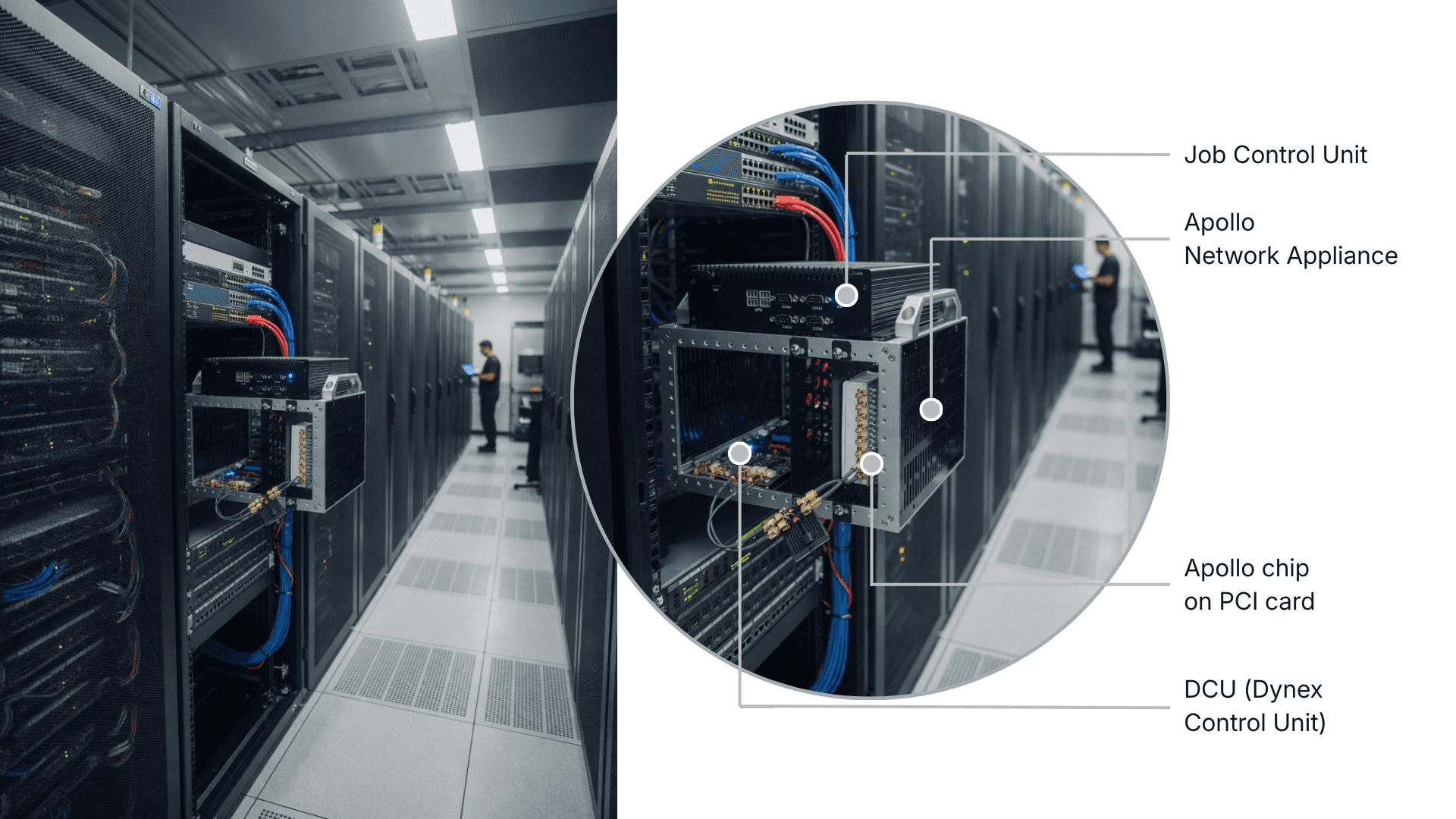

Quantum-Driven Computing at Scale
Apollo is designed as a high-throughput, room-temperature quantum-driven neuromorphic processor with 10,000 fully parallel p-qubits, a high-degree Δ256/Hyperion interconnect, and continuous-time stochastic dynamics rather than clocked digital update cycles. In practical terms, its performance comes not only from raw scale, but from the combination of dense native embedding, analog in-memory vector–matrix coupling, independent entropy-driven p-qubit switching, and very short annealing runtimes. The Apollo paper reports a typical analog-core power envelope of approximately 0.5 W, p-qubit transition dynamics on the order of 12.5 ps, and energy cost of ≤10 fJ per transition, positioning Apollo as a physically scalable optimization engine rather than a conventional gate-model quantum processor.
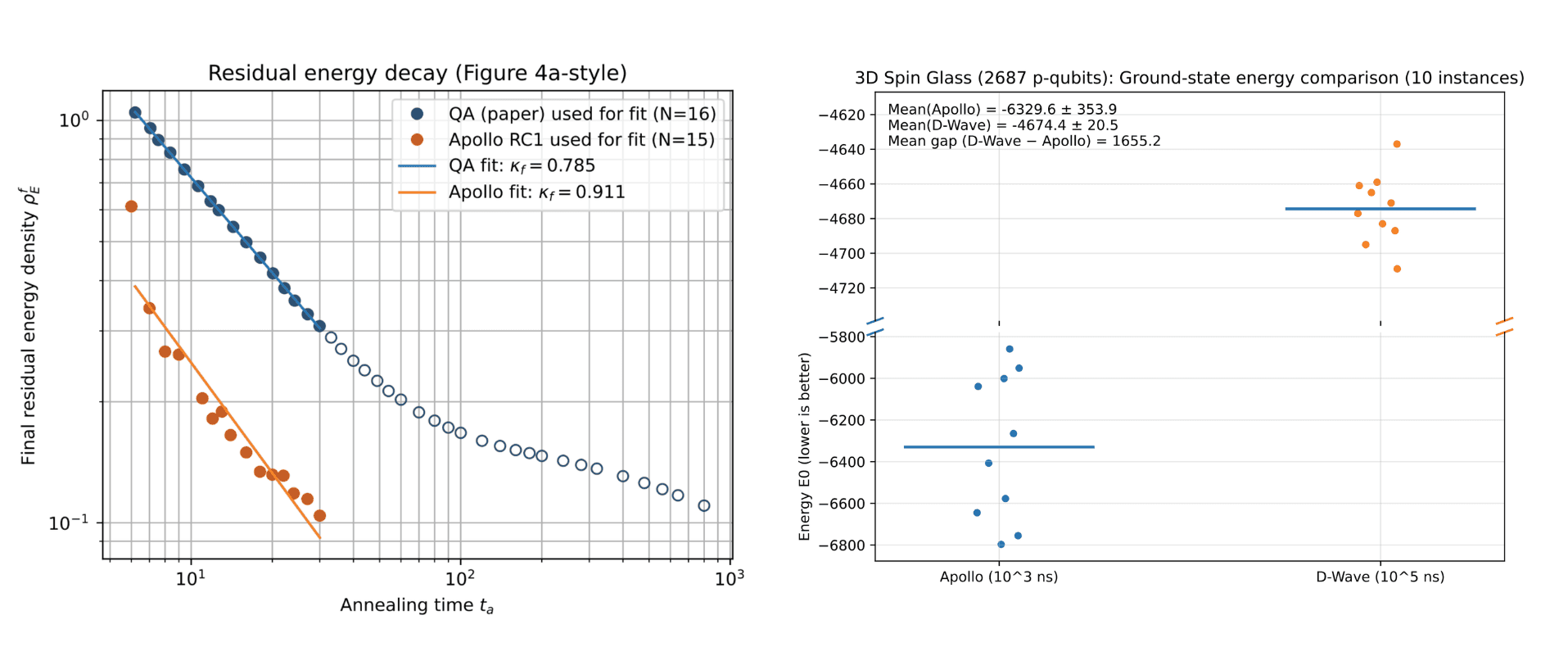
In benchmark terms, Apollo’s performance places it beyond the capabilities of currently known quantum hardware for large-scale spin-glass optimization workloads. Existing gate-based quantum systems and alternative annealing platforms are not publicly known to natively solve spin-glass problems at this scale with comparable embedding efficiency, solution quality, and runtime characteristics. The clearest example is the three-dimensional Edwards–Anderson spin-glass benchmark with 2,687 spins: Apollo reproduces the quantum-critical residual-energy scaling associated with superconducting quantum annealing, while also reaching substantially lower — more negative — ground-state energies than the D-Wave reference data, despite operating at two orders of magnitude shorter runtime. This makes Apollo’s advantage not merely a theoretical scaling claim, but an experimentally benchmarked performance result on one of the most demanding and widely recognized tests for quantum annealing hardware.
> A. Ivanov, S. Rahmeh, E. G. S. Nascimento, and D. Herrmann, “Quantum-Driven Neuromorphic Computing for Million-Qubit-Scale Workloads,” arXiv preprint arXiv:2606.12968, 2026. doi: 10.48550/arXiv.2606.12968.
> The science behind Dynex
> Benchmarks
Three Foundations of Quantum-Driven Neuromorphic Computing
The Dynex Apollo series introduces a new computational architecture designed to accelerate optimization, probabilistic inference, and energy-based machine learning. Unlike conventional processors that execute deterministic instructions, Apollo performs computation through the stochastic physical dynamics of interacting probabilistic elements.
At the heart of this architecture is a new computational primitive known as the p-qubit (probabilistic qubit). A p-qubit is a stochastic binary unit whose state fluctuates between 0 and 1 under the influence of both deterministic inputs and controlled randomness.
Apollo’s computing substrate is built on three fundamental technological pillars:
Mixed-Signal Analog CMOS Fabric
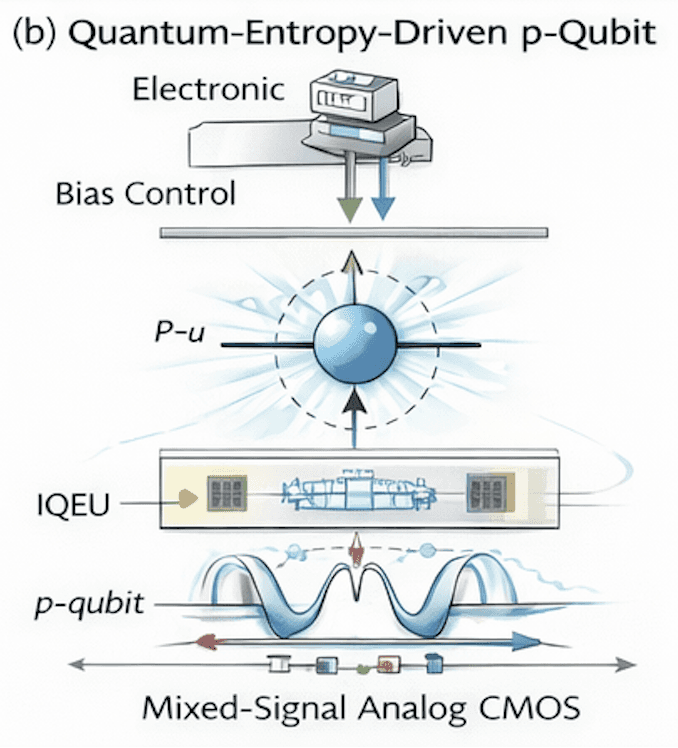
Quantum-Entropy-Driven p-Qubits
Continuous-Time Energy-Based Computation
Together these elements form a scalable hardware platform capable of exploring complex energy landscapes far more efficiently than traditional digital computing systems.
1. Mixed-Signal Analog CMOS Fabric
Apollo is implemented as a mixed-signal analog CMOS processor fabricated using advanced semiconductor technology. Instead of representing computation purely through digital logic gates, the system combines analog signal processing with digital programmability.
Each p-qubit is realized as a low-power analog circuit element whose state is determined by the weighted sum of inputs from neighbouring nodes, programmable bias parameters, and stochastic entropy signals. The analog circuitry computes these interactions continuously in time, eliminating the need for discrete clocked update cycles.
This mixed-signal approach provides several key advantages:
• extreme parallelism, with thousands of nodes evolving simultaneously
• ultra-low energy per update, since computation occurs through physical relaxation rather than digital switching
• high-bandwidth interaction networks, implemented through analog coupling circuits
• CMOS manufacturability, enabling large-scale integration using standard semiconductor processes
By embedding probabilistic computation directly in silicon, Apollo transforms the processor into a physical dynamical system whose behavior mirrors statistical mechanics models used in optimization and machine learning.
2. Quantum-Entropy-Driven p-Qubits
A defining innovation of the Apollo architecture is the integration of one quantum entropy source per computational node. Each p-qubit receives stochastic input from a dedicated Integrated Quantum Entropy Unit (IQEU). These entropy generators exploit quantum physical processes present in nanoscale semiconductor devices, such as electron tunnelling fluctuations and quantum shot noise.
Unlike pseudo-random number generators used in digital probabilistic hardware, IQEUs produce true non-deterministic entropy directly in hardware. This randomness is injected into the p-qubit dynamics to drive stochastic state transitions.
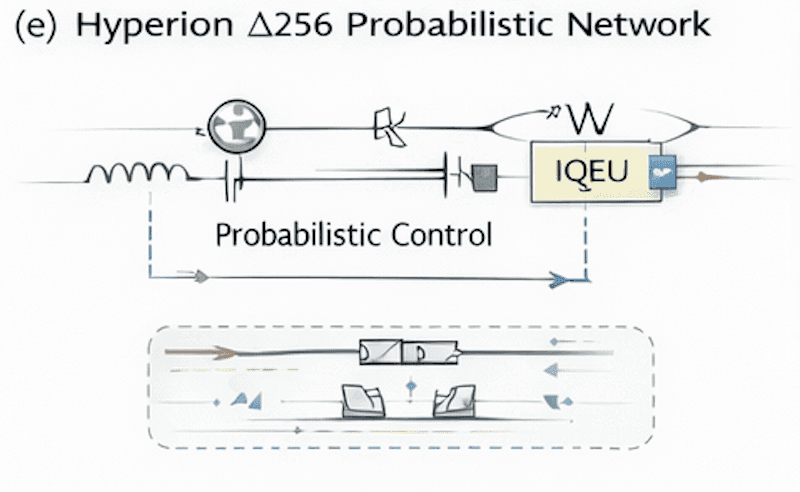
Providing independent entropy for every node offers several critical advantages:
• eliminates noise correlations across the computing fabric
• preserves statistical independence required for correct Boltzmann sampling
• enables extremely high switching bandwidth
• ensures accurate thermodynamic behaviour of the probabilistic network
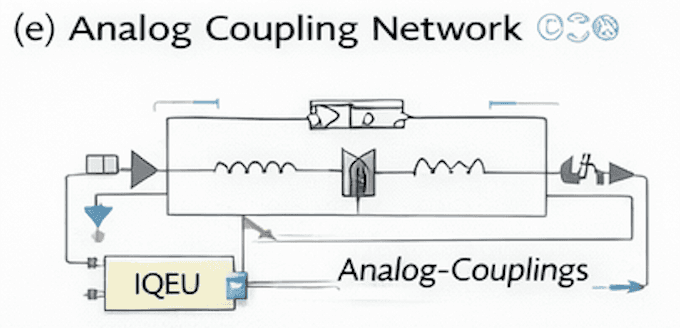
Through this design, Apollo elevates the traditional p-bit concept into what Dynex refers to as a p-qubit: a probabilistic computing element whose stochastic behaviour is powered by quantum-derived entropy.
3. Continuous-Time Energy-Based Computation
Traditional processors perform computation through sequential instruction execution. In contrast, Apollo performs computation through the continuous-time relaxation of a physical energy landscape.
Each p-qubit continuously evaluates its local field according to:
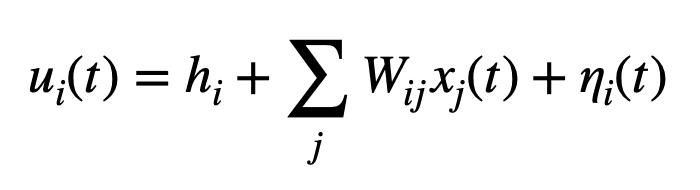
where:
• Wij are programmable couplings between nodes
• hi is a local bias field
• ηi(t) is stochastic entropy injected by the IQEU
Because the network evolves asynchronously, all p-qubits update simultaneously according to their local conditions. The resulting dynamics resemble physical systems such as:
• magnetic spin glasses
• stochastic neural networks
• Boltzmann machines
• interacting particle systems
As the system evolves, it naturally relaxes toward low-energy configurations of the underlying optimization problem.
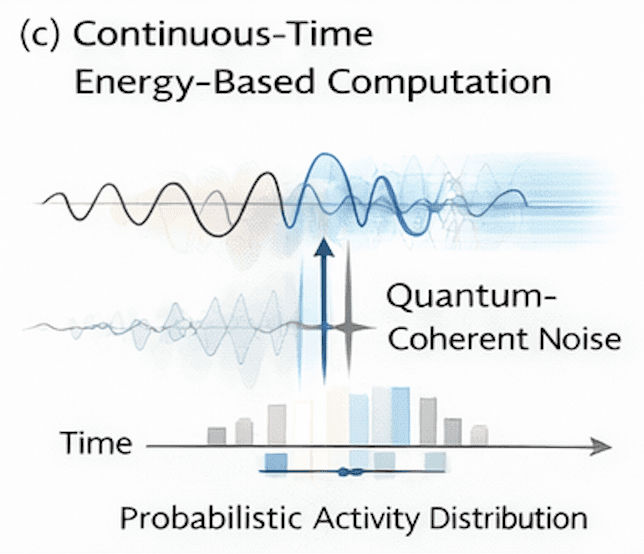
This continuous-time stochastic evolution provides several advantages:
• massive parallel exploration of solution spaces
• natural avoidance of local minima
• rapid convergence toward optimal configurations
• extremely low energy consumption per update
The result is a computational substrate that behaves less like a digital computer and more like a physical energy-minimization engine.
Emergent Probabilistic Computing Fabric
When thousands of p-qubits interact through programmable couplings, the Apollo processor forms a large-scale probabilistic computing fabric capable of solving complex optimization and inference problems.
The collective dynamics of the network naturally implement:
• Ising energy minimization
• Boltzmann sampling
• stochastic neural computation
• probabilistic graphical models
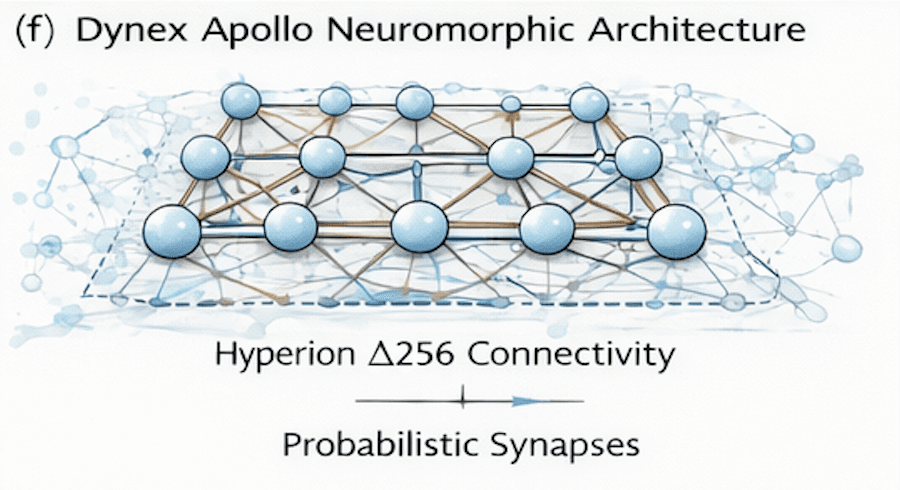
Because the interactions are implemented directly in analog hardware, the system can explore energy landscapes with extremely high bandwidth compared to software-based Monte Carlo simulations.
System-Level Architecture
Apollo integrates the p-qubit fabric with the Dynex Control Unit (DCU), an FPGA-based orchestration system responsible for programming, scheduling, and monitoring computation.
The system architecture consists of multiple functional layers:
• classical control electronics
• programmable bias and noise injection systems
• analog coupling and synaptic routing fabric
• p-qubit probabilistic computing layer
• measurement and readout subsystems
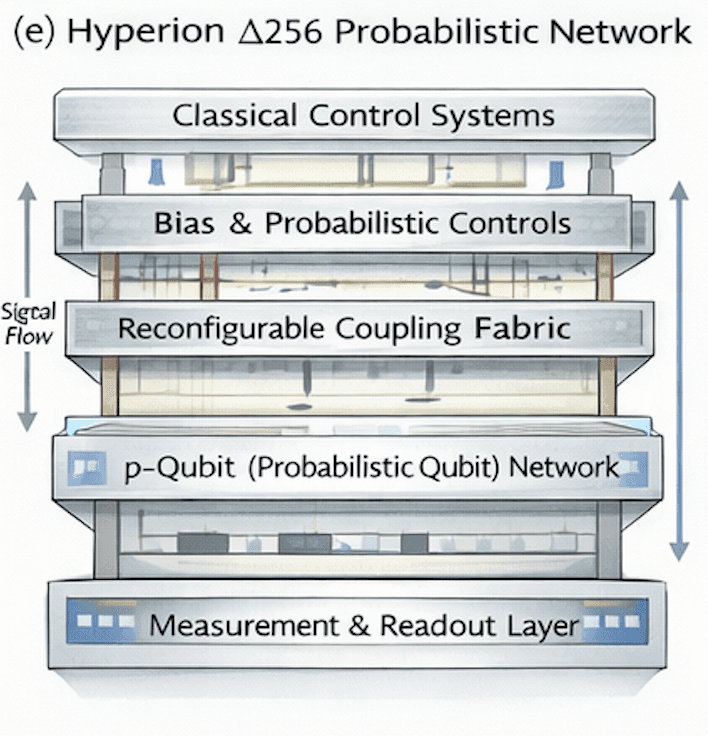
Together these components form a hybrid analog-digital platform capable of executing a wide range of probabilistic algorithms.
A New Class of Computing Hardware
By combining mixed-signal analog CMOS circuits, quantum-derived entropy sources, and continuous-time probabilistic dynamics, Apollo introduces a fundamentally new computational paradigm.
This architecture enables hardware systems that can efficiently solve problems traditionally considered intractable for conventional processors, including:
• large-scale combinatorial optimization
• probabilistic machine learning
• energy-based generative models
• complex physical simulations
Apollo therefore represents a major step toward scalable probabilistic computing hardware capable of operating at room temperature using standard semiconductor technology.
Learn more:
> Quantum Powered Solutions
> Dynex Quantum Platform: A cloud-based, qubit-agnostic platform
> The Science Behind Dynex