Quantum-Driven Solution Development
Dynex empowers organizations to turn complex, high-value problems into measurable results through next-generation quantum-driven computation. Our qubit-agnostic platform combines diamond-spin quantum computing hardware (Zeus series), analog p-qubit hardware (Apollo series), CPU/GPU-accelerated quantum circuit emulation, external quantum computing systems and a scalable cloud infrastructure—enabling enterprises to achieve breakthroughs that were previously out of reach using classical or superconducting quantum systems.
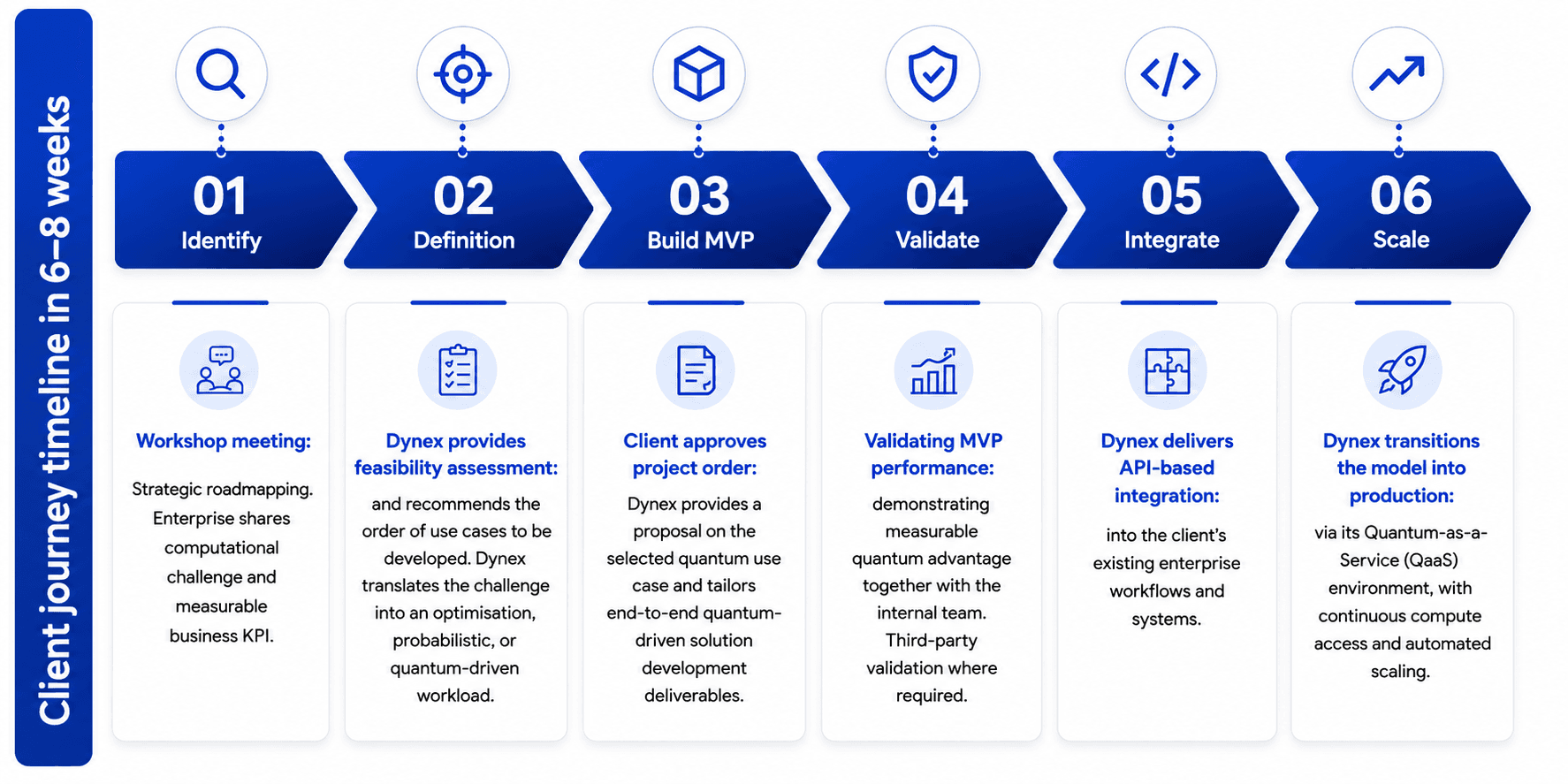
Our model is simple: identify the right challenge, define where quantum-driven computation creates measurable value, build and validate an MVP, integrate it into existing workflows, and scale it into production. Whether optimizing critical operations, accelerating scientific discovery, improving computational outcomes, or transforming data-driven decision-making, Dynex develops end-to-end quantum-driven solutions designed for real-world deployment.
A Guided Journey From Challenge to Production
1. Identify: Define the Business Challenge
Every engagement starts with a focused workshop. Together with the customer, Dynex identifies a clearly defined computational challenge and the measurable business KPI that matters most.
We look beyond whether a problem can simply be “made quantum.” The objective is to determine where a different computational approach can create meaningful value—through better optimization, improved accuracy, faster computation, lower resource requirements, new discovery capabilities, or reduced energy consumption.
The result is a clearly defined problem statement and an initial roadmap for the most promising use cases.
2. Definition: Assess Feasibility and Quantum-Driven Potential
Dynex performs a technical feasibility assessment and determines how the challenge should be formulated computationally. Depending on the problem, this may involve optimization, probabilistic computing, quantum-driven algorithms, hybrid classical-quantum workflows, or other specialized computational approaches.
Potential use cases are evaluated according to:
Computational suitability: Which formulation and computational architecture best fits the problem?
Performance potential: Where can Dynex technology improve outcomes compared with existing approaches?
Business relevance: Does the expected improvement translate into measurable operational, scientific, or financial value?
Implementation feasibility: Can the solution be integrated efficiently into the customer’s existing environment?
Dynex then recommends the use cases with the strongest development and commercialization potential.
3. Build MVP: Develop the End-to-End Solution
Once the customer approves the selected project, Dynex defines the scope, objectives, KPIs, required data, integration requirements, and development deliverables.
Our specialized Quantum-Driven Solutions Developers then build the MVP using Dynex proprietary technology, selecting and combining the computational resources best suited to the problem.
This is not simply access to quantum compute. Dynex develops the complete solution around the computational challenge—including problem formulation, algorithms, optimization logic, data preparation, execution workflows, validation mechanisms, and the interfaces required for deployment.
4. Validate: Demonstrate Measurable Performance
The MVP is tested against clearly defined performance criteria using real-world or representative customer data.
Dynex works together with the customer’s internal team to measure the resulting computational and business advantage against relevant existing methods and benchmarks. Depending on the application, validation may include solution quality, computational time, scalability, accuracy, resource utilization, energy requirements, or other agreed KPIs.
Where appropriate, results can also be independently validated by third parties.
The objective is straightforward: demonstrate measurable advantage before moving into production.
5. Integrate: Connect With Existing Enterprise Systems
Once the solution is validated, Dynex integrates it into the customer’s existing technology environment.
API-based interfaces connect the quantum-driven solution directly with enterprise applications, data sources, operational systems, analytics platforms, and existing workflows—allowing the customer to use advanced computational capabilities without rebuilding its infrastructure around them.
The result is a production-ready solution that becomes part of the customer’s normal operating environment rather than an isolated experiment.
6. Scale: Transition Into Production
Dynex transitions the validated model into production through its Quantum-as-a-Service (QaaS) environment, providing continuous access to the computational infrastructure required to operate and scale the solution.
Production deployment can include:
Continuous quantum-driven compute access
Automated workload execution and scaling
API-based enterprise integration
Monitoring and performance optimization
Model and algorithm updates
Ongoing technical support
Expansion into additional datasets, business units, or use cases
As requirements grow, Dynex scales the computational resources behind the solution without requiring equivalent increases in infrastructure or specialist resources on the customer side.
> Contact us
> Case-studies & use-case examples